


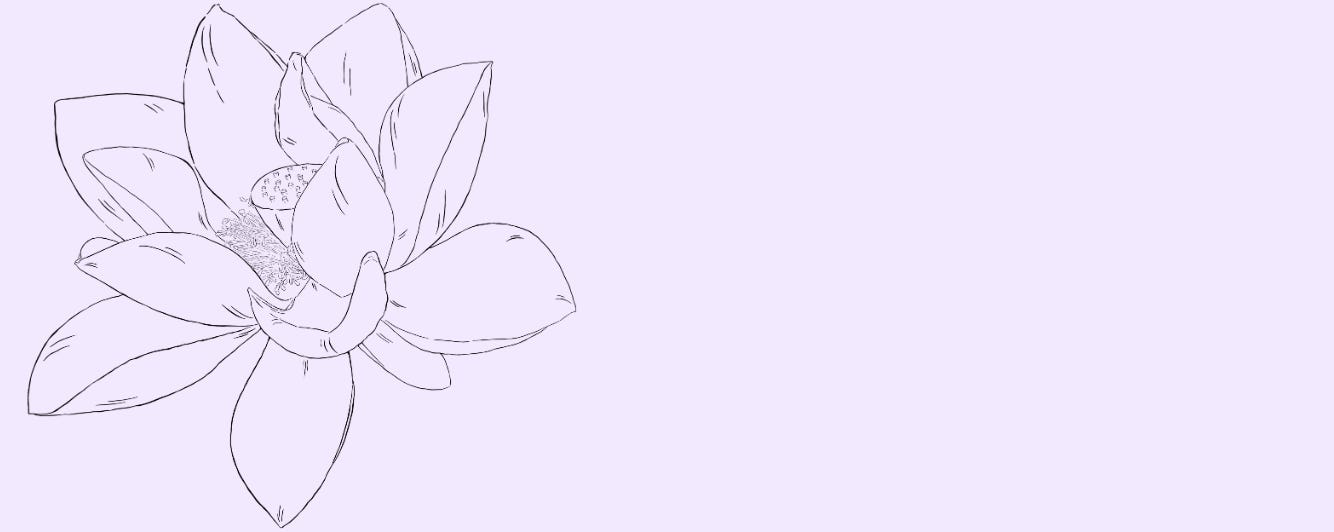
“I didn’t know a lotus could bloom outside this time of year.”
The garden is small, but well-kept: clusters of peonies; wisterias growing off vines; bushes of hydrangeas in lilac, periwinkle, and pink. And there, in a small pond, a lotus in full bloom at the dwindling end of winter. There isn’t a hint of ice on the surface of the water despite puffs of foggy breath swirling together between the two women standing under starlight.
The owner of the garden smiles, even and polite. She’s tall and willowy, with pin-straight hair that brushes against the backs of her knees; a conspicuous figure amongst the gently curving grasses and leaves. “I haven’t seen you here before.”
The village is small. It always has been—even after the narrow, dirt roads were paved; even after horses were traded in for metal boxes; even after the villagers decided they preferred staring at an image of a flower on a screen the size of their palm over feeling the softness of a petal under their fingertips. Even if the villagers have little interest in herbs and bouquets now, the gardener knows every face that resides in this village.
The outsider’s mouth—full, like a blooming rose—quirks up into a smile. “I was just passing by.”
“I don’t get many visitors these days.” Especially not this late into the evening, especially not from someone out of town.
“Could I have a tour?” The visitor steps closer, cold dirt crunching under her shoes. “My name is Nitya.”
It doesn’t take long to walk through the serpentine path, but the gardener stops to point out each flower with care: tulips, marigolds, and daisies. And her care shines through; not a single flower wilts under her watch. Each one of them is in perfect bloom, even if the flower is months away from when it should be thriving. No two flowers are the same, delineated by a label with a single letter and a year. The latest addition—a burgundy dahlia—was brought in twelve years ago.
Minutes pass by as though clock hands have been caught in sap. Nitya’s movements are slow too, like a fawn taking her first steps into the vast world before her. Maybe this is her first time in a garden like this; the world has changed so much, after all. Maybe she lives in one of those towns where the buildings reach towards the clouds and artificial lights glitter brighter than the stars.
But Nitya’s hands are gentle when they brush over the rounded leaves of a money plant. And in turn, the stems almost seem to surge towards her touch, as if asking for more.
The moon finally peeks out from behind a cloud when Nitya leaves. But before she can take the last two steps over the threshold, she turns back, loose curls fluttering around her heart-shaped face. “I didn’t catch your name.”
When the owner of the garden smiles this time, it’s a slow rearrangement of sharp features settling into something softer. “Pallavi.”

“Where did you find all these flowers?” If Nitya was beautiful under the gentle light of the moon, then she’s radiant under the warmth of the sun. “I’ve seen photos of many of these, but some I’ve never heard of at all.”
Nitya returns to the garden again and again, each visit longer than the last. Sometimes Nitya wanders in silence as Pallavi watches. And sometimes, like today, she talks up a storm.
Pallavi traces her fingers over the ridges of the trunk of the tree they sit under: the only cherry blossom in her possession. “A visitor like you gifted this to me.”
“A visitor like me?” Nitya looks up at Pallavi through her long, long eyelashes.
A few petals flutter down between them from the branches above. “Years ago, back when the borders of this land were open.”
“And they gifted it to you personally?”
“I invited her to dinner, and she gave me this in return.” Pallavi’s eyes soften at the memory.
“An entire tree?” Nitya laughs, a chime in the wind. “But cherry blossoms don’t grow here, I know that much. And if this was from before the barriers—well, that would make you at least eighty years old.”
“Maybe I am.” Pallavi offers a wry smile. There isn’t a single wrinkle on her face. “Maybe I’ve been around for even longer.”

Time passes differently in this garden. Pallavi can’t recall exactly how long she’s been here, how many seasons have passed by. But she doesn’t forget a single visitor, no matter how fleeting their time may have been.
The trunk of the tree is thick. The bark is rough under Pallavi’s skin. When Nitya doesn’t reply, she draws her hand back. “Are you frightened?”
“Should I be?”
A fair question, but not one that’s often asked. Pallavi tilts her head back. She’s seen peace and war, she’s seen humans reach the furthest depths of the sea and heights beyond what should be possible. She’s seen societies curl back into themselves, shunning the world around them that they had worked so hard to amalgamate. But the sky is the same blue it’s always been since the first time she opened her eyes. “I believe fear is born from misunderstanding.”
Gentle fingers curl around Pallavi’s wrist, Nitya’s palm hot where Pallavi’s skin is cool. “I’m not afraid.”
It’s a rainy afternoon when Nitya reaches for her hand again, her skin warm and slick after refusing any sort of cover. Mud spatters across her feet with each step, soft soles unused to earth beneath them. Her fingers trail over a chrysanthemum. “You’re surrounded by reminders of your lovers, then.”
Droplets of rain cling to Pallavi’s eyelashes, momentarily blurring the image of Nitya when she blinks. But she refuses to miss a single second and fights to keep her eyes open. The woman before her no longer feels like a mere visitor. No—she looks like she belongs here, like she’s been a part of this little garden all along. “You aren’t jealous?”
“How could I be when they gave you company?” It isn’t the first time Nitya has brought up her concerns: It must be lonely to exist in this world for as long as you have. She worries, perhaps too much, about every being around her—from her elderly neighbors to her peers, as undeserving as they are; from the smallest dandelion to the undying woman who has tended to a humble garden for centuries. Nitya is kind, perhaps to a fault.
This chrysanthemum was planted seventy-six years ago: the sprout bursted through the soil long before Nitya’s soul touched the earth. “Then, do you want to know who this was from?”
The garden is an archive, a book bound with yellowed pages and petals carefully pressed within.
She tells Nitya about Sanjana, the priest’s daughter. Aisha, the governor’s wife. Chandni, the sister of the crown prince. She tells Nitya about Bhavana, the spinster. Farah, the maiden, promised to the merchant’s son in the next village over. Jyoti, who was like Nitya in some regard, brimming with possibilities, yet—in quieter moments, when shadows would envelop her face—listless.
“But they didn’t have to be all those things with you, did they?” Nitya wraps her arms around Pallavi’s waist, pulling her closer, raindrops dancing over her cheeks.
Back then, ensnared in the storm of politics, Aisha would call the garden an oasis and Chandi likened it to the grounds she’d gallivant as a child. Sanjana said it was a reprieve from witnessing her father’s dealings behind drawn curtains, where paper and coins were stronger than a sermon.
This whole town thinks there is something wrong with me, is what Bhavana said, mouth set in a grim line that came to soften with time.
I hope they find something wrong with me, is what Farah lamented, adamant on freeing herself from her impending marriage.
And Jyoti whispered before giving Pallavi a bluebell with drooping indigo petals: I wish I knew what was wrong with me.
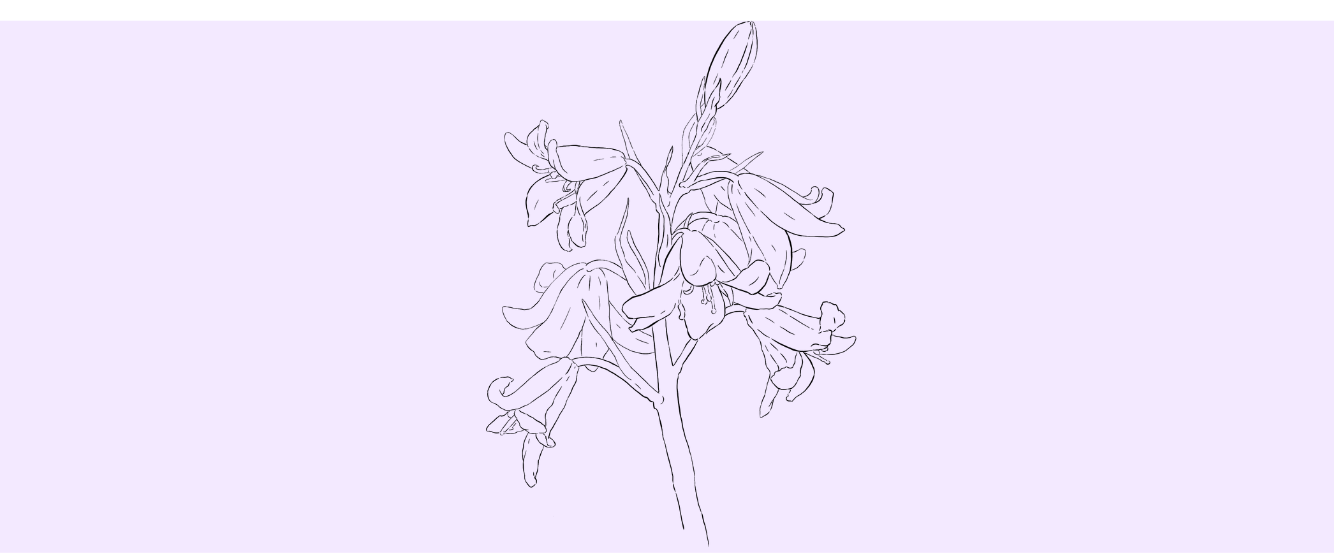
“Here, they only had to be Sanjana, Aisha, and Chandni.” The back of Nitya’s hand brushes over a lily. It sways closer in return. “They didn’t have to be more than Bhavana, Farah, and Jyoti.”
Pallavi dips her chin, her hair forming a curtain around their faces. “What makes you so sure of that?”
“When I’m with you, I only ever have to be me.”
Nitya stays for years.
She stays through sweltering summers and frigid winters. She stays through weeks of dry when most flowers would cry, and weeks of rain when most flowers would sing. And the flowers never changed, always perfectly in bloom.
But Nitya changes. It starts with a single hair turned gray in a head full of inky black. Then, a wrinkle between her brows, at first only visible when she frowns. And then, lines on either side of her mouth, a vestige of her laugh. She’d complain of a chill and her joints would ache if she sat on soil for too long to tend to the bush of roses she’d grown partial to.
“It’s lonely, you know, to live as long as I have.”
It’s late winter again. Nitya is cold, so she insisted on draping both of them with a shawl while they stare out at the garden, admiring how the moon paints every surface it can reach silver.
“I can only imagine.” Nitya keeps her voice low. She’s always quiet at night, not wanting to disturb the flowers. She would always say they’ve felt alive in a way that went beyond simple grasses, ferns, and shrubs. She claimed they breathed the way that she does, moved the way that she does. And at first, she paid it no mind. But then, her gaze would linger on the fluttering petals even when Pallavi insisted it was just a breeze passing by.
“What if you didn’t have to imagine?” An offer to her Nitya, who has always been so kind. What if I didn’t have to be alone?
“What do you mean?”
“What if you stayed here with me?” Pallavi smiles, century-seasoned to keep her voice even. “Just you and me, in our garden.”
“Stay with you…Forever?”
Pallavi cups Nitya’s cheek delicately, though every muscle fights to clutch her lover’s face instead, to hold onto this moment in time. Because each inhale is another second less that they have together.
She brushes her thumb next to the corner of Nitya’s eye where fine lines are starting to appear too. No, that wouldn’t do at all. “You wouldn’t age. You wouldn’t grow ill. You wouldn’t have to worry about a single thing. You could stay with me, just like this.”
“Just like this…?” Nitya tilts her head to the side, her words even slower than her movements, like they’ve been caught in sap.
Pallavi’s smile grows. She doesn’t have a heart anymore. Maybe she never had one to begin with, a hollow creature from the moment she opened her eyes and found a bright blue sky, everpresent yet just out of reach. If she did have a heart, would the even rhythm quicken? Would it skip a beat?
Nitya leans into her touch, her cheek softer than a poppy petal.
Yes—just like this, free from constraints of time and the world around them.
After all, only Pallavi could see her lovers when the rest of society cast them away. Only she treasured their beauty where everyone else found faults. Only she could provide peace in chaos, freedom in subjugation, happiness in a sorrow-filled world. Only she could grant eternity.
Wouldn’t Nitya love that? Why spend hours, days, years of her life here if she didn’t want to stay? Together in this garden. There’s no greater gift Pallavi could grant.
“Darling, close your eyes for me, won’t you?”
Pallavi doesn’t like her lovers seeing her like this, after all.
It’s rather unsightly: the way her jaw unhinges with a wet pop and a second, then third row of jagged teeth burst through her gums. Her dark eyes fade to pale, the warmth they once held hardening into something cold, sharper than the spikes of thistles and barberries.
Some of her lovers cry; perhaps the potential of longevity becoming a reality surprises them.
Some of her lovers scream; perhaps in shock that a beauty such as Pallavi could conceal a side like this.
Some of them lose control of their bodily senses, fluids leaking from between trembling legs.
Some of them think they’ll change their minds, and think it better to run. But Pallavi does not take the curation of her garden lightly. They rarely get far.
She tastes Nitya’s rose lips first.
It takes exactly seven days for a seed to form in the pit of Pallavi’s stomach.
She knows when she lurches out of bed, overcome with the urge to vomit. Sweat beads at her temples, and there’s a tiredness deep in her bones that weighs her down, begging her to stay in place—but she mustn’t. Over seven days, her stomach has swollen to three times its normal size, her skin stretching to accommodate. Another wave of nausea crashes into her. She’s ready now.
Even with staggered steps and ragged breaths, she carries herself up the flight of stairs with as much poise as she can muster. It’s unusually cold for a spring morning; winter doesn’t want to leave just yet. Crisp air seeps into the house through the cracks in the windows and gaps in the doors, but Pallavi doesn’t feel it.
The nursery is barren for the most part. It’s the most important and the least used room in this little house at the edge of the garden. Hand-crafted flower pots line the walls, no two like the other. Most were sculpted by Pallavi’s practiced hands, but a few were molded by Nitya, uneven and charming.
Pallavi settles on the hard floor in the center of the room. She’s used to it. She’s done this time and time again for hundreds of years. But it’s her least favorite part.
She lets her jaw fall open until her chin bumps against her swollen belly, copper hitting her tongue as rows of teeth emerge in her mouth. Alone in her home, she lifts a willowy hand and reaches into her mouth—past her teeth, knuckles rubbing against her palate. She doesn’t gag anymore when her hand plunges down her throat. Her esophagus pulses around her wrist, but it doesn’t resist the intrusion.
The inside of her stomach is hot, juices sloshing as she gropes around, searching, searching, searching, until—there. A seed, tiny and smooth between her fingers.
Tears spring to her eyes. All of Nitya’s love, her youth, preserved in this little seed, left behind for Pallavi to nurture until the end of time.
She retches and yanks her arm out, falling back onto the floor with the force of it. Goosebumps rise to her skin where cool air meets the mess of liquids on her arm.
“Oh, pretty darling.” Pallavi cradles the seed in her palm and brings it close to her chest. “I wonder what you’ll be.”
R. S. Thakur (they/them) is a queer South Asian-American writer based in New Jersey.
Wow. Just...wow. Flowers as gifts from lovers in a timeless garden, away from a society that forgot or chose to forget the beauty of what is temporary, what shouldn't be taken for granted. I've fallen in love with flowers all over again. I need a full book of this story!